California AI Workforce Playbook: What Every WDB Director Should Know Before October 15, 2026
“Stop Hiring Humans.” I photographed that billboard on my way into San Francisco Chamber of Commerce Small Business Week last month. Three words in large type, placed where commuters, workers, and business owners see it every day. The ad belongs to an AI automation company, Artisan, and was designed to provoke. It succeeded.
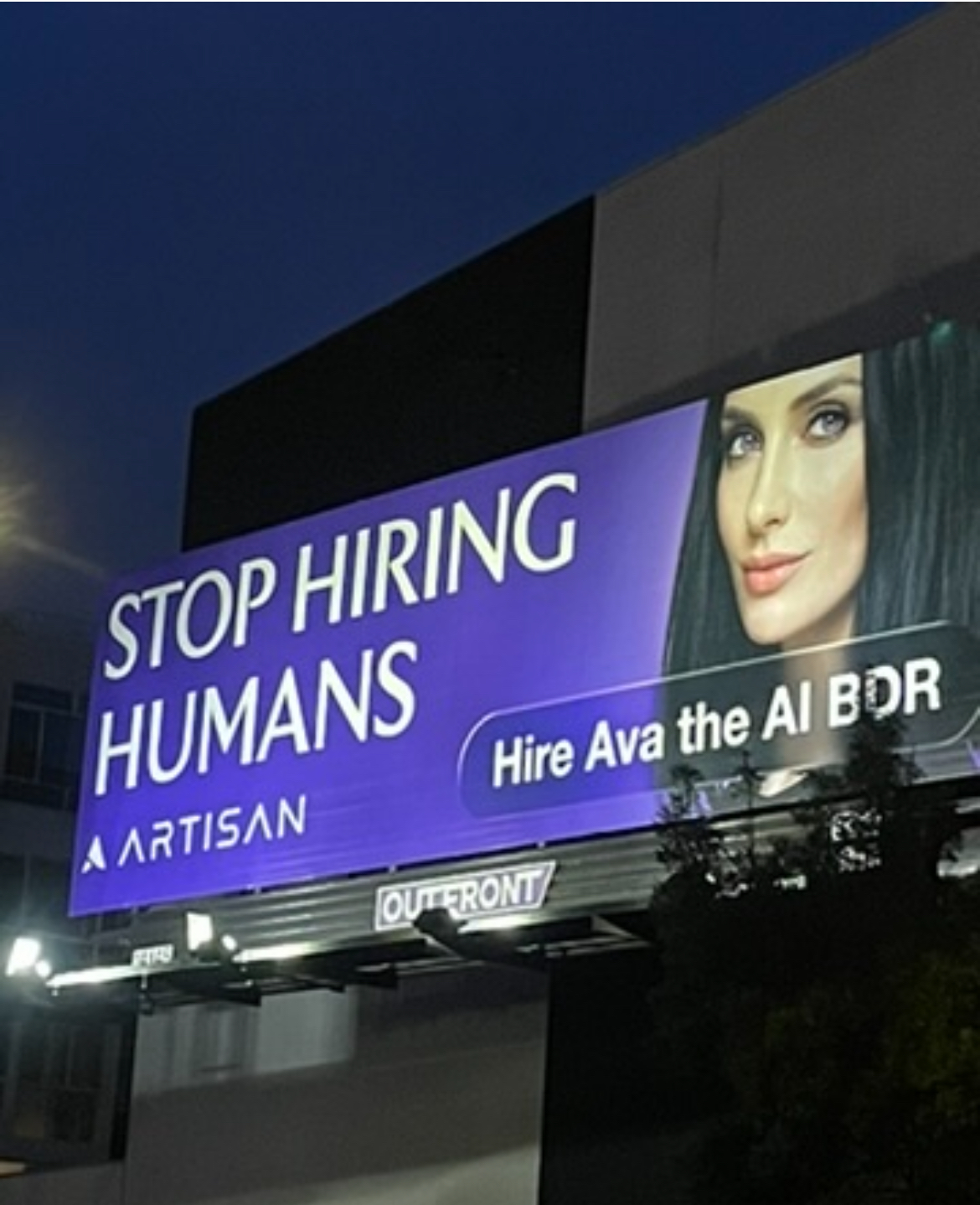
The reception was held inside Saint Joseph’s Arts Society, a 22,000 square foot National Historic Landmark church founded by designer Ken Fulk in 2018 and transformed into a cultural hub for San Francisco’s arts community. Small business owners who have spent years building something were there alongside employees of the large San Francisco corporations that sponsored the event. The billboard outside is a signal of where this economy is moving, how fast, and how little warning anyone is getting.
Those workers, those business owners, those families navigating uncertainty in neighborhoods across California are your constituency. In direct response to the disruption that billboard represents, Governor Newsom signed Executive Order N-6-26 on May 21, 2026. The question for every workforce development board director in this state is the same: what are you building in response, and will it be ready by October 15?
What Does California Executive Order N-6-26 Require of Local Workforce Development Boards?
Section 5 of the executive order contains a specific directive for local boards. The Employment Development Department, in partnership with local workforce development boards, shall develop an AI playbook to expand dislocated worker strategies for occupations exposed to AI. It provides local boards with technical assistance on the utilization of Workforce Innovation and Opportunity Act resources for AI literacy-related programs. The deadline is October 15, 2026.
Three deliverables live inside that mandate:
A regional analysis identifying which occupations in your area are most exposed to AI displacement or transformation.
A set of dislocated worker strategies specific to those occupations and your regional labor market.
A technical assistance framework demonstrating how existing WIOA resources can be legally and effectively applied to AI literacy programming.
EDD leads the statewide playbook. But local boards are named as partners in building it. You are not waiting for a document to arrive from Sacramento and then implementing it. You are building your regional piece now, in parallel, with the local labor market intelligence and program knowledge that only your board has. Boards that are waiting will not be ready when EDD asks.
Why Won’t Existing Workforce Programs Meet the October 15 Mandate?
Workforce development programs, by design, are largely funding-responsive. When there is appropriated funding for construction careers, healthcare pathways, or infrastructure training, boards build programs that serve those workers. That programming should continue because it serves workers building careers in, for example, construction, healthcare, and infrastructure.
But the AI mandate is asking for something structurally different. Understanding that difference is the first step toward meeting it.
Consider a heavy equipment operator. Her core work is not disappearing tomorrow. What is changing is the ceiling on her professional value. An operator who uses AI tools to monitor materials costs, flag equipment maintenance needs, and track project milestones does not just protect her position. She becomes a strategic contributor to her employer rather than a replaceable pair of hands. She gets her cognitive attention back from solely the rote operation of the equipment. Her expertise does not become obsolete. It becomes the intelligence that directs the system.
That same shift is available to the prep cook who uses AI to optimize kitchen inventory and reduce food waste, to the medical biller whose AI flags claim errors before submission, freeing him to spend time with the patient who is confused and frightened about a bill he cannot afford. In every case, the worker who can direct AI systems earns more, contributes more strategically, gaining value, enrichment, and compensation that rote work alone could never provide.
This is what AI workforce transition requires boards to build toward. Most current program inventories, however strong, were not designed for it. That is not a failure of leadership. It is a system now being asked to move faster and further than its 2014 inception required.
What Should Your Regional AI Workforce Strategy Contain?
Your regional AI workforce strategy has three core components, each flowing directly from the mandate:
A regional occupation exposure analysis. Which specific jobs in your area face the highest near-term displacement risk? Which are positioned for augmentation? This requires current labor market data mapped against AI adoption trends in your region’s specific industries, not national averages applied generically to your geography.
A dislocated worker strategy specific to those occupations. Not a tool tutorial. A sequenced learning pathway designed for workers navigating real uncertainty about their professional future, built around what they already know and where your regional economy is actually going.
A WIOA resource utilization plan for AI literacy programming. Which existing funding streams can legally support this work? What does compliance documentation require? What does a program officer review look like when AI literacy is the program category?
A difference between the technical layer and the transition layer determines whether any of this works in practice.
The technical layer teaches a worker to use an AI tool such as ChatGPT as an extended Google search. This results in limited outputs from limited inputs, which she copies and pastes. She does not learn power: to prompt for specific results, to direct and train the AI architecture, and to build executable AI systems.
The transition layer is the curriculum architecture that determines whether that training actually changes how she works. It accounts for who is sitting in that seat: a professional with expertise and legitimate questions about whether this transition is for her. Her existing knowledge must be honored and built upon. Discarding it guarantees failure.
A training program that skips the transition layer produces completion certificates. Deeper capacity to direct AI systems, to think strategically, and to apply new skills on the job never develops.
A program built with both layers produces workers who perform in an AI-augmented economy. The mandate requires the latter. Most AI training on the market today delivers only the former.
Digna Vita AI builds the regional AI workforce strategy your board brings to EDD's playbook. Learn more about our work.
What Questions Should a WDB Director Ask Right Now?
Before your board builds anything, these questions are worth answering honestly.
If EDD called tomorrow and asked for your regional list of AI-exposed occupations, could you name the top five in your area? Could you tell them what percentage of your current program participants work in those fields?
Does your existing program inventory include a sequenced AI transition pathway? Not a tool tutorial, but a structured learning experience designed for workers whose professional identity is tied to the work they have always done?
When did you last review which of your current WIOA funding streams could be applied to AI literacy programming? Do you have a compliance rationale ready if a program officer asks?
If any of these questions surfaces a gap, that gap is exactly what you'll want closed before EDD asks.
What Do California’s Displaced Workers Need Their Workforce Boards to Build?
That billboard is still up on the way into Saint Joseph’s Arts Society, a National Historic Landmark church rescued from thirty years of abandonment and transformed into a cultural hub for SoMa’s arts community. Today, the same economic forces that put “Stop Hiring Humans” on that billboard are pushing artists out of the neighborhood Saint Joseph’s was built to serve.
Economic disruption moves faster than the institutions built to absorb it. That is not new. What is new is the speed, the scale, and the October 15 deadline that asks your board to respond with dislocated worker strategies and a legally sound technical assistance framework to shift some WIOA resources to AI literacy programming.
Your community appointed you to lead its workforce system during this monumental shift. Not to file a report. Not to check a compliance box. To build a regional strategy for workers, families, and communities whose economic futures depend on whether their workforce board leads or manages around what is coming.
The mandate tells you what to build. The workers, families, and communities in your region need you to deliver it.
Frequently Asked Questions About California’s AI Workforce Mandate
What does Executive Order N-6-26 specifically require of local workforce development boards?
EDD, in partnership with local workforce development boards, must develop an AI playbook that expands dislocated worker strategies for occupations exposed to AI and provides technical assistance on using WIOA resources for AI literacy programs. The deadline is October 15, 2026. Local boards are named as active partners in this work, not passive recipients of a state document. That means every board needs its own regional framework now, built on local labor market data and program intelligence. Read the full text of Executive Order N-6-26 here.
What is the difference between AI workforce readiness and AI workforce transition?
AI workforce readiness typically means introducing workers to AI tools and building basic digital literacy. AI workforce transition goes further. It addresses the full arc of change: identifying which occupations in a region are most exposed, designing sequenced learning pathways that build on workers’ existing expertise, and measuring whether training produces lasting change on the job. The October 15 mandate requires transition-level strategy, not readiness-level programming.
Which California occupations are most exposed to AI displacement?
Exposure varies significantly by region and industry mix. Nationally, occupations with high rates of routine cognitive tasks, including administrative support, data entry, claims processing, and customer service, face the highest near-term augmentation or displacement risk. In California, regional labor markets vary widely. A board serving the Central Valley faces a different exposure profile than one serving Silicon Valley or Los Angeles. Your regional strategy requires an occupation exposure analysis built on local labor market data, not national averages.
Can existing WIOA funding be used for AI literacy programs?
Yes, with the right compliance framework in place. WIOA Title I Adult and Dislocated Worker funds can support training for workers in AI-exposed occupations when the program meets eligibility and documentation requirements. The October 15 mandate specifically directs EDD and local boards to develop technical assistance on exactly this question. Boards that have not reviewed their funding streams against AI literacy program requirements have a gap to close before they can be a useful partner on this piece of the mandate. Before applying any WIOA funding stream to AI literacy programming, boards should have legal counsel or a compliance officer review the application to confirm eligibility and documentation requirements are met.
How long does it take to build your regional AI workforce strategy?
A rigorous regional playbook, including occupation exposure analysis, dislocated worker strategies, and a WIOA resource utilization plan, requires 10 to 12 weeks when built by a team with the right methodology and regional labor market expertise. Boards reading this in June have a workable window. Boards that wait until August do not. The first step is a regional readiness assessment that establishes where your board currently stands and what the playbook needs to address. Starting now is the difference between showing up ready on October 15 and showing up empty-handed.